









Bipolar Species: Which Animals Live At Both The North & South Poles?

The Arctic and the Antarctic are as far apart from one another as you can get on Planet Earth, yet these “polar opposites” have plenty of overlap and parallels when it comes to their biological communities.
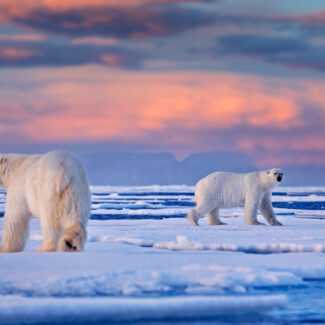
There are, of course, many differences in polar fauna when comparing the Northern Hemisphere with the Southern. Spectacularly isolated from other continents for a long swath of geologic time, Antarctica claims no native land mammals, for example—and, indeed, no native, truly terrestrial animal larger than a midge. Compare that to the Arctic, still host to a fair share of flashy “megafauna”: polar bears, muskoxen, caribou/reindeer, and wolves, to name some prominent examples. And an extremely important contingent of Antarctic (and sub-Antarctic) fishes, the notothens—which include among their ranks the impressively sized Patagonian and Antarctic toothfishes—has no real counterpart in the Arctic.
But there are not only many close cousins in evidence at the highest latitudes of the Northern and Southern hemispheres, but quite a few specific species that make their presence known on both the top and bottom of the world. In this overview, we’ll explore the concept of “bipolar” animals in a technical sense as well other critters (or related groups of critters) with “feet” (if you will) in both northern and southern polar reaches.
A Quick Overview of “Bipolarity” as a Biogeographic Concept
Long explored and debated among biogeographers and taxonomists, bipolarity refers to organisms, whether single species or simply closely related forms, which are found in the polar latitudes of both the Northern and Southern hemispheres, but not in the lower latitudes in between—though that latter point requires an asterisk. An asterisk, because there’s documentation of some of these supposedly bipolar taxa (as scientists call an evolutionarily related population or population group) from very deep waters in equatorial latitudes. That “equatorial submergence” suggests that some organisms with an affinity for cold waters—and thus found at shallow depths in the chilly polar zones of the planet—may enjoy genetic interchange across the vast distances between the Arctic and Antarctic via the plenty-cold deeps of the World Ocean.
That interchange, for example, may see tiny, even microscopic life, including in egg or larval form, drifting and spreading via the deepwater currents that are part of the global “thermohaline circulation” across centuries or millennia.
It’s also possible that some bipolar species once enjoyed a broader, fully connected geographic distribution that became severed by continental rifting or climatic shifts, thereby isolating high-latitude populations in respective hemispheres. This sort of geographic cleavage can, of course, eventually result in the splintered populations gradually evolving apart into distinct, if related, species.
The real nature and extent of bipolarity remain hot topics of scientific speculation, and it’s possible that some understudied species declared as bipolar may be genetically different enough to warrant taxonomic splitting—or are actually more broadly distributed on Earth than currently realized. But, at this point, many taxa across all kinds of biological divisions have been proposed as bipolar: from various foraminifera and bacteria to bryozoans, crustaceans, molluscs, and even vascular plants (especially certain sedges).
Examples of Animal Species & Groups Found in Both the Arctic and Antarctic
When you include not only truly bipolar life-forms but also organisms with much more extension distributions, you end up with quite a menagerie of animals and kinds of animals that inhabit both the Arctic and the Antarctic.
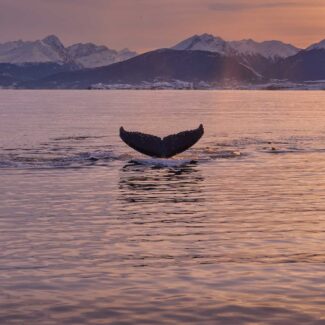
Those include a bevy of marine invertebrates of both bipolar and more cosmopolitan biogeography, including the copepods and euphausid krill so foundational in polar marine food webs. Indeed, many marine creatures range into polar waters of both hemispheres, including a spectacular lineup of cetaceans that seasonally visit the Arctic and the Antarctic to feed. Blue whales, the most enormous critters on Earth, will summer in subpolar and polar waters as part of an annual migration that also includes balmier, lower-latitude wintering grounds. Male (aka bull) sperm whales, the largest toothed predators on the planet, will do the same, diving to pursue fish and squid in these chilly and productive depths. And orcas or killer whales also use polar waters, functioning as top predators wherever they’re found. (Of the number of different forms or ecotypes of orca that marine biologists recognize—some of which, eventually, might be deemed their own subspecies or even, perhaps, species—at least four have been identified in Antarctica.)
These along with some other baleen whales may forage along the edge of the sea-ice pack or even (as with blue whales and their little cousin the minke whale) roam about some within the pack. But they’re not as disposed to travel extensively under the ice and seek out farflung leads and polynyas for breathing holes, which is partly why they’re mainly only summer visitors to the poles (though our warming climate may be changing that pattern).
Among the fishes, a couple of notable groups are shared between the polar waters of the Arctic and the Antarctic, notably the eelpouts (zoarcids) and the snailfishes (liparids). Big, even huge, sleeper sharks of the genus Somniosus, are found in the Arctic and Subarctic—the Greenland and Pacific sleeper sharks—while a close relative, the southern sleeper shark, prowls in the Southern Ocean, with a confirmed sighting right on the doorstep of Antarctica itself taking place in January 2025, when a good-sized individual was filmed off the South Shetland Islands at a depth of about 1,600 feet. (Interestingly, recent years have turned up documentation of large sleeper sharks—most associated with cold high latitudes—in deep equatorial waters, suggesting the possibility they may be more widespread at depth than previously thought.)
At the taxonomic family level, lots of close relatives inhabit both northern and southern polar environments. Take, for example, the “true” or earless seals: the phocids. They’re among the most numerous large mammals in both the Arctic and the Antarctic, with a range of species intimately adapted to polar sea ice—the “ice seals”—which includes the bearded, ribbon, harp, ringed, and hooded seals of the Arctic and the Weddell, crabeater, Ross, and leopard seals of the Antarctic. Plenty of seabird families have both Arctic and Antarctic representatives, including some species that pop up in both zones (as we’ll dig into shortly).
Sidebar: The Commonplace Penguin & Polar-Bear Mixup
On this general subject, let’s take a moment to address among the more enduring misconceptions about polar fauna. It’s all too common to see depictions of polar bears and penguins rubbing shoulders, leading many people to labor under the false notion that these animals inhabit the same ecosystems.
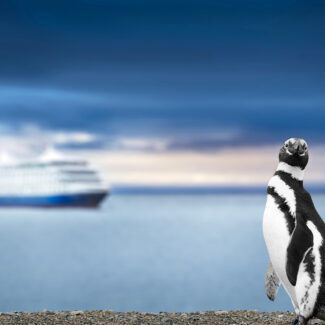
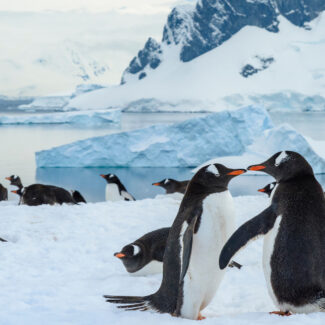
In fact, polar bears and penguins never clap eyes on one another in the wild. That’s because polar bears are firmly Arctic beasts, while nearly all penguins are found in the Southern Hemisphere—with the one exception, the Galapagos penguin, barely claiming a foothold in the Northern Hemisphere right along the equator. No question the mighty “ice bear” and that waddling contingent of boldly patterned, flightless seabirds—which reach their greatest diversity in the Southern Ocean—are among the best-known denizens of polar environments. It’s just that they happen to inhabit opposite polar environments and don’t cross paths (which, presumably, the penguins are quite content with, given the polar bear’s predatory predilections).
What might be the “penguin of the Arctic?” The closest counterparts in the Far North are probably the alcids, a seabird group that includes such stubby swimmers as puffins, razorbills, murres, guillemots, and auklets. A bygone temperate and Subarctic alcid, the great auk, was all the more penguin-ish, given its large size and flightless nature—truly the “penguin” of the Northern Hemisphere. Unfortunately, human greed and overhunting pummeled this magnificent creature to extinction in the 19th century.
Meanwhile, the nearest thing to a polar bear down in the Antarctic might be the formidable leopard seal, a bruiser of a pinniped with a taste not only for krill and fish but also penguins and other seals.
Far-Traveling Polar Birds—Including the Special Case of the Remarkable Arctic Tern
As mentioned, numerous families of seabirds, not least the petrel or tubenose family, include closely related Arctic- and Antarctic-ranging cousins. But some individual seabird species themselves bridge at least some of the gap between the two poles.
Short-tailed shearwaters, for example, may fly between sub-Antarctic waters and the Chukchi Sea, while the long-tailed jaeger nests in the High Arctic but winters out in the Southern Ocean.
Most impressive of all is the Arctic tern, whose common name partly misrepresents this seabird. That’s because it conducts a mind-blowing annual migration between the Arctic and the Antarctic, chasing the sun from its boreal-summer breeding grounds to its austral-summer hangouts on the Antarctic pack ice. Different Arctic-tern populations have different migration routes and specific nesting geographies, but the longest, truly globe-spanning journeys see them winging upwards of 51,000 miles (82,000 kilometers) round-trip each year.
The Arctic & the Antarctic: Both Astonishing Destinations for Polar Wildlife Viewing
Both the Arctic and the Antarctic rank among the greatest destinations on Earth for wildlife enthusiasts, who simply can’t go wrong with either! The spectacles can be awe-inspiring indeed: humpback whales rolling off the glacier-scarved Antarctic Peninsula, the swoop of a snowy owl over Arctic barrens, raucous gaggles of penguins in the Far South and raucous gaggles of puffins in the Far North—it goes on and on, and it’s yours to explore on one of our polar expedition cruises.
From the bird cliffs of Svalbard and the caribou pastures of Nunavut to the sub-Antarctic elephant-seal arenas of South Georgia and the orca hunting grounds of the ice-littered Weddell Sea, this is first-class nature appreciation, to say the least!

Arctic Animals: The Wildlife At The Top Of The World
A Guide To Arctic Plants: Surviving & Thriving In The Tundra
Arctic Food Web & Ecosystems Explained: From Tundra To Ocean
The Polar Paradox: Why Are There No Penguins In The Arctic?
Reindeer Revelations: 9 Captivating Caribou Facts
A Guide To Arctic Whales & Whalewatching On An Arctic Cruise
A Cruisegoer’s Guide To The Seals Of The Arctic & Sub-Arctic
No, I am the Walrus: 10 Whimsical Facts About Walruses
Twitching At The Top Of The World: A Guide To Arctic Birds
Disclaimer
Our travel guides are for informational purposes only. While we aim to provide accurate and up-to-date information, Antarctica Cruises makes no representations as to the accuracy or completeness of any information in our guides or found by following any link on this site.
Antarctica Cruises cannot and will not accept responsibility for any omissions or inaccuracies, or for any consequences arising therefrom, including any losses, injuries, or damages resulting from the display or use of this information.