


East Greenland, Scoresby Sund, Including Long Hikes


Highlights
- Sail among cathedral-sized icebergs in the immense fjords of Scoresby Sund, where glaciers and basalt peaks frame a sublime Arctic panorama.
- Encounter musk oxen, Arctic hares, whales, seabirds, and possibly polar bears in one of the High Arctic’s richest wildlife realms.
- Explore by Zodiac and on foot across tundra and along glacier fronts, visiting Inuit settlements and ancient Thule remains.
This expedition ventures into the heart of East Greenland’s Scoresby Sund, the largest fjord system on Earth and one of the planet’s most dramatic Arctic landscapes. Here, mountains rise in near-vertical walls from deep, iceberg-choked waters, their layered basalt faces glowing in shifting polar light. Vast glaciers calve into silent inlets, and the tundra rolls outward in sweeping valleys where musk oxen graze beneath immense skies. The scale is humbling, the remoteness profound, and the sense of true exploration unmistakable.
Navigating deep into branching fjords such as Øfjord and Rødefjord, guests experience a world sculpted by ice and time. Colossal icebergs—some grounded in surprisingly shallow channels—drift like frozen cathedrals through still waters, while glacier fronts crack and thunder in the distance. In certain periods, the Arctic light grows especially evocative, with long, luminous evenings and, when conditions align, the ethereal shimmer of the aurora borealis dancing above the mountains, adding a rare and magical dimension to the voyage.
Wildlife encounters are an integral part of the journey. Whales surface in nutrient-rich waters, seabirds wheel above cliff faces, and the tundra reveals Arctic hares and grazing musk oxen. In more remote reaches, there is the possibility of glimpsing narwhals or even polar bears, reminders that this is a thriving High Arctic ecosystem. Visits to Ittoqqortoormiit and the scattered remains of ancient Thule dwellings offer insight into the resilience and ingenuity of those who have long called this austere region home.
Exploration here is immersive and active. Guests venture ashore for guided hikes across tundra and along ridgelines, some routes designed for those eager to stretch their legs on longer walks through mythic landscapes. Zodiac cruises we...
Ships
Standard Activities
About the East Greenland, Scoresby Sund, Including Long Hikes
This expedition ventures into the heart of East Greenland’s Scoresby Sund, the largest fjord system on Earth and one of the planet’s most dramatic Arctic landscapes. Here, mountains rise in near-vertical walls from deep, iceberg-choked waters, their layered basalt faces glowing in shifting polar light. Vast glaciers calve into silent inlets, and the tundra rolls outward in sweeping valleys where musk oxen graze beneath immense skies. The scale is humbling, the remoteness profound, and the sense of true exploration unmistakable.
Navigating deep into branching fjords such as Øfjord and Rødefjord, guests experience a world sculpted by ice and time. Colossal icebergs—some grounded in surprisingly shallow channels—drift like frozen cathedrals through still waters, while glacier fronts crack and thunder in the distance. In certain periods, the Arctic light grows especially evocative, with long, luminous evenings and, when conditions align, the ethereal shimmer of the aurora borealis dancing above the mountains, adding a rare and magical dimension to the voyage.
Wildlife encounters are an integral part of the journey. Whales surface in nutrient-rich waters, seabirds wheel above cliff faces, and the tundra reveals Arctic hares and grazing musk oxen. In more remote reaches, there is the possibility of glimpsing narwhals or even polar bears, reminders that this is a thriving High Arctic ecosystem. Visits to Ittoqqortoormiit and the scattered remains of ancient Thule dwellings offer insight into the resilience and ingenuity of those who have long called this austere region home.
Exploration here is immersive and active. Guests venture ashore for guided hikes across tundra and along ridgelines, some routes designed for those eager to stretch their legs on longer walks through mythic landscapes. Zodiac cruises weave between towering bergs and along glacier fronts, while time on board is enriched by expert lectures, wildlife briefings, and panoramic observation from deck and lounge. Each day balances education, adventure, and quiet moments of awe.
Traveling through Scoresby Sund fosters a rare sense of perspective and achievement. Few places on Earth feel as vast, silent, and elemental. This itinerary is ideally suited to adventurous travelers, photographers, wildlife enthusiasts, and those drawn to remote frontiers where nature reigns supreme. Guests return not only with striking images and stories, but with a deeper connection to the Arctic’s scale, beauty, and enduring spirit of exploration.
Itineraries
Long hikes:
Long Hikes are for groups of passengers, accompanied by two armed expedition staff and a Zodiac that will sail ahead to watch for polar bears along the shoreline. Passengers who join this activity should have the willingness and ability to walk at least 15 km (9 miles) in semi-rough terrain that includes shorelines, tundra, low hills, and river crossings. Walks will take around six hours from start to finish, rest times included. We will walk at a modest pace and not cross any alpine terrain. Passengers who do not take part in long walks will have a landing in the morning at the start point of the walk, then sail to the end point of the walk for their second landing in the afternoon.
On the Iceland road
Your journey begins in the morning – the scent of adventure is on the air! By request, you can transfer via chartered bus (T) from the bus stop at Harpa Concert Hall and Conference Centre at Austurbakki, Reykjavik (the meeting point), to the ship in Akureyri (the embarkation point). You arrive in the afternoon after a six-hour drive through the beautiful landscapes of Northern Iceland.
PLEASE NOTE: This transfer (T) must be booked and paid for in advance. In the early evening, the ship departs from the port of Akureyri, sailing north toward the Denmark Strait.

Sailing to east Greenland
Arriving at Earth’s largest fjord
Colors of the cape
Enormous bergs, Arctic hares
Settlement at Scoresby Sund
Stewart Ø
Remote shores
Sea life
Journey’s end at Akureyri
All itineraries are for guidance only. Programs may vary depending on ice, weather, and wildlife conditions. Landings are subject to site availabilities, permissions, and environmental concerns per AECO regulations. Official sailing plans and landing slots are scheduled with AECO prior to the start of the season, but the expedition leader determines the final plan. Flexibility is paramount for expedition cruises, and willingness to compromise on comfort is a basic requirement on a historic sailing vessel. Important information about the use of sails: The vessel is equipped with sails to be used in good conditions (based on open sea, water depth, wind, and time allowance), but the use of sails is not guaranteed. The captain decides whether to use the sails or engine. If sails are used, the crew will operate them. Guests must follow the safety instructions of the team. The average cruising speed for s/v Rembrandt van Rijn is 6.5 knots.
Please note: End of trip
This trip concludes with a crossing of the Denmark Strait. Since Northern Atlantic weather can be rough in October, the captain will decide when to depart East Greenland to make for the most pleasant crossing.
Push-off at Constable Point
You arrive by chartered plane from Keflavik and land at Constable Point, the airfield at the head of Hurry Inlet. This area is known for its remarkably rich geological history.
Sailing among the glaciers
Inuit neighborhood of yesteryear
Mountain-fringed fjord
The tundra of Jameson Land
Settlement at Scoresby Sund
Under the northern lights
Journey’s end in Akureyri

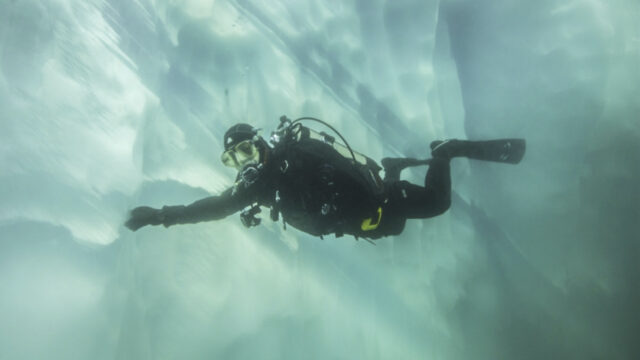
The farthest reaches of the far north are home to some of the world’s most iconic wildlife, of which polar bears and Arctic foxes are just a part. On our Arctic dive program, you can encounter not only wondrous sea life but beautiful ice formations that truly distinguish this region from Antarctica.We make shallow dives that explore near or under ice floes (about nine meters, or 30 feet deep) as well as deeper shoreline dives (nine to 18 meters, or 30 to 60 feet deep).In the Arctic, we may also encounter seals, sea lions, and walruses. When these beloved animals are close to the Zodiacs, we may try to observe them underwater using snorkels and masks. But because of the possible danger, we cannot dive with walruses.
Weather in the polar regions
Arctic voyages are organized during the Northern Hemisphere summer (May to September), when the weather is milder. During this period, the sun shines 24 hours per day and temperatures often range between 5 to 15°C (41 to 59°F).In Antarctica’s Southern Hemisphere summer (December to February), temperatures are generally close to freezing, varying between -5 to 8°C (23 to 46°F). Combined with the strong katabatic winds of this area, the cold can often feel even colder.Warm and waterproof clothing (and a flexible attitude) is required for both regions, especially Antarctica. Severe weather may lead to the cancellation of landings and dives, as excursions can only take place in safe conditions.
Program changes due to weather and ice
We know our dive destinations in great detail and are always exploring new sites, but every dive can encounter surprises. It is important to remember that nature calls the shots in the polar regions. Personal expectations that are not met are not grounds for reimbursement.Please note that our itinerary is always subject to safe local conditions. It is always possible that ice, weather, or wildlife will force us to change our sailing schedule. It is also possible that certain bays or fjords will be closed because of ice.In such cases, we always have planned alternatives. But again, these alternatives are not grounds for reimbursement. When changing the itinerary, we assure you that the captain, expedition leader, and dive leader will do their utmost to provide you an equally good replacement program.
Dive experience and qualifications
Our polar dive voyages are not for beginners. They are meant for experienced divers who are familiar with cold-water, dry-suit diving. You must have logged at least 30 dry-suit dives to participate.Before departure, please present an internationally accepted diving certificate (at least Advanced Open Water) and logbook. Also, we ask that you include copies when completing your diver personal information form.
The first dive of our voyage will be a “check dive” to try out your gear and assure our dive leader that you have enough experience to participate. This is for your safety and that of our guides.If our dive leaders feel that any diver does not meet the necessary experience, they can exclude that diver from the dive program. In this event, Oceanwide Expeditions cannot be held responsible and will grant no claims for reimbursement.All divers are required to follow the instructions of dive leaders and guides at all times. All divers are participating 100% at their own risk, which is also the case during land excursions.
Expedition team, excursions, & dive leaders
Our expedition team consists of one expedition leader and multiple guide-lecturers. All members of the team are extensively experienced in working in the polar wilderness.Every morning after breakfast, you will be informed of the day’s program (position of the vessel, general information about the area, itinerary, and expected wildlife during the excursions). The excursions will then be evaluated in the afternoon and after dinner.
Occasionally, the expedition team will organize lectures, sometimes supported with slide shows, to inform the passengers about various features of the polar environment.Our dive leaders are highly experienced instructors assisted by one or two dive guides. The main language of all guides and dive operations is English unless otherwise stated.
Special note: Safety first
Diving in the remote polar regions is no more dangerous than normal scuba diving as long as you follow one important rule: safety first.All divers looking for dangerous stunts or deep dives are asked to refrain from this activity. There are no decompression chambers in Antarctica or the Arctic, medical care is almost non-existent, and there is hardly any infrastructure. Although we have a doctor on board the vessel for first-aid assistance, we cannot accept risky ventures from any divers.
DIVE PROCEDURES
Approach to dive siteIn normal circumstances, the number of divers per Zodiac is six passengers as well as one driver-guide. Always watch your valuable gear when embarking and disembarking the Zodiacs. Oceanwide is not liable for the loss of individual equipment.
Check dive
The voyage starts with a check dive so that all divers can get used to the cold water, try out their equipment, and determine the weights they need. Before each dive, there will be a briefing about the dive site, weather and ice conditions, and the procedure of the dive.
Currents
Water currents can be present anywhere and at any time. The dive guides will select a dive spot that is safe and also give information about returning to the Zodiacs if needed. Normally there is very little current where we dive, if any.
Dive buddy
Dives will be made using the buddy system. The dive guide will not be in the water to accompany and lead divers. Rather, dive guides stay on the surface for the divers’ safety. Divers are expected to be experienced enough to read their compasses and depth gauges and look after each other. Buddy teams are important, so we let our divers match themselves as much as possible. In cases where divers have not paired up or are in doubt, dive guides sit with divers to discuss their expectations and experience. We try to pair people of similar interests and experience. If there is an uneven number of divers and three-person groups are not feasible, dive guides will accompany divers.
Dive guide-to-diver ratio
Our programs allow for six divers per dive guide, with a preferred maximum of 24 diving passengers per voyage. Groups larger than 24 will need to split dive activities, and we also may reduce the number of dives so that we can safely manage activities.
Drifting pack ice
This is a real hazard. If pack ice approaches while divers are underwater, it can be hard to see people if they surface in the middle of it. For this reason, it is important to only dive around icebergs that are hard aground or floating in water clear of brash or pack ice. Many of the dive sites have slopes or faces that go deeper than the 20 meters (65 feet) maximum limit for our dives. Divers must act responsibly and show self-discipline.
Equipment
Once you have settled into your cabin, you will be given an area to store and hang your equipment. Every diver is expected to prepare their own equipment in advance of each dive. Bring your own spare parts for regulators and dry suits in case of leaks or damage. Divers are expected to set up and carry their own equipment in and out of the Zodiac as well as up and down the gangway.
Number of dives
We plan for one to two dives per day, but an exact number of dives cannot be given due to the possibility of variable ice and weather conditions.
Visibility
Ample pack ice often means flat water with clear visibility. Little pack ice can mean plankton blooms, because there is more daylight and possibility of swells. But the ice and weather conditions are different every year, so there is no way to predict them.
DIVE EQUIPMENT
Please bring the following equipment yourself:
Dry suit with hood
Two sets of warm underwater garments
Dry gloves or wet gloves/mitts adequate for sub-zero waters
Two freeze-protected regulators. (We dive with special bottles that have two separate outlets, and we use 12L steel tanks fitted with a Y or H valve configuration and DIN or Yoke (INT) adaptable connections.)
Stabilizing jacket or BC with quick-release capability and sufficient lift capacity
Pressure gauge
Compass watch
Knife and torch
Mask, fins, and snorkel
Dry suits
These are the only adequate protection in Arctic and Antarctic waters, which can be as cold as –1°C (30°F). The type of dry suit you use is not important so long as it fits you, is waterproof, and you are comfortable using it.Neoprene dry suits have the benefit of good stretch and extra insulation. Shell suits provide no extra insulation but are lighter and dry quicker. They serve only to keep you dry and require extra layers of garments under the suit. If possible, bring a small dry suit repair kit.
Dry suit accessories
If a hood is not attached to your dry suit, you will need to bring one. A 7mm neoprene hood with face and neck seal is recommended.Regular 7mm neoprene semi-dry gloves or mitts may also be used with any dry suit and are relatively easy to use. Three-finger mitts are warmer than five-finger gloves. You can also use special dry gloves that seal against rings on the arm of the dry suit.To prevent glove squeeze and promote warmth, short pieces of surgical tubing or straws can be inserted under your wrist seals to allow air exchange between your suit and gloves. This type of glove requires additional practice, as they can fall off if not used correctly.
Face masks
We recommend a standard mask, but the type of mask you use is not critical. You may use a full-face mask if you are experienced with them. Commercial defogging agents work well for polar diving.
Please keep an extra face mask handy in case your regulator free flows. Straps can also become brittle in cold weather, so we highly recommend bringing a spare strap and mask.
Insulating undergarments
The colder the water, the more (and thicker) layers of undergarments are required. We recommend you wear two or three layers, depending on your suit.As the first layer, you should wear a set of polypropylene liners. This material helps absorb moisture from the body. As the second layer, wear thick insulating material like fleece, synthetic pile, Thinsulate, or similar. As the final outer layer, we suggest a windproof shell.The one-piece jumpsuit style is the most common and comfortable configuration of dive wear. It is available in a variety of thicknesses, depending on your dry suit and the water temperature.
Post-dive clothing
It is important to bring a warm hat and warm waterproof gloves to wear before, and especially after, your dives.
Regulators
Normal regulators will not function where we dive, since both the first and second stage could freeze. You are therefore required to bring two sets of regulators (first and second stage) suitable for cold-water diving.
Some regulators can be fitted with an environmental seal kit, while others come environmentally sealed from the manufacturer. To avoid regulator malfunction, regulators must be cared for properly before, during, and after dives.Avoid breathing from the regulator before submersion, except to briefly ensure it is functioning. When doing so, exhale after removing the regulator from your mouth to avoid freezing the second stage with moisture from your breath.If your primary regulator freezes and causes a free-flow, switch to your back-up regulator and turn off the valve to the primary regulator. We avoid rinsing regulators with fresh water between dives to minimize the risk of freezing. We rinse all equipment at the end of the trip.You will need the two sets of regulators described below:
First set, including:
Freeze-protected first stage and second stage (including hose)
Hose for BC
Submersible pressure gauge (SPG)
Second set, including:
Freeze-protected first stage and second stage (including hose)
Hose for dry suit
Tips to keep regulators free of water
Always open the cylinder valve briefly to blow out any moisture before mounting the regulator from the orifice.
When purging the regulator for removal, hold the second stage lower than the first stage so that water cannot drip back to the first stage after the pressure has dropped.
Remove the regulator carefully to keep ice and water from falling into the filter.
Dry the dust cap thoroughly before attaching it to the regulator.
Fit the dust cap snugly before rinsing the regulator.
Do not press the purge button while rinsing the regulator.
Shake excess water from the second stage before hanging the regulator to dry.
Equipment we provide on board
Tanks
On all diving vessels, we have a compressor and 35 steel tanks of 12 liters each (200 bar), with DIN and Yoke adaptable connections and two separate outlets.
Weights
You will be provided with hard lead weights and a belt, but there are no ankle weights available. You may bring and use your own weight harness.
Your voyage apart from diving
Diving in Antarctica and the Arctic is a fantastic adventure, but our usual land outings are alsoamazing. With the prior approval of your expedition leader, you can choose to participate in our thrilling shore excursions and Zodiac cruises instead of diving. This combination characterizes the uniqueness of our voyages, which will give you the ultimate polar experience.Our Zodiacs can take you safely into beautiful fjords, among pack ice, and to shore sites. We usually organize one morning excursion and one after lunch. The duration of excursions may vary, but they normally take three to four hours.
While you are on land, it is important to follow the instructions of our guides. It is not allowed to leave the group. In the Arctic, for example, we must take polar bear danger seriously. Polar bears are naturally camouflaged, so they can show up anywhere and attack without warning.We also cannot touch, remove, or take or anything else from the environment or its monuments. This includes plants, stones, feathers, or anything else.Disturbing the animals is also highly forbidden. Some birds nest on the ground, so be careful where you walk, and do not approach nests. When a bird’s nest is disturbed, it is extremely vulnerable to predators looking for eggs and chicks.
Diving FAQ & final notes
How deep do we dive?
Our maximum depth is 20 meters (65 feet). Many dive sites have slopes or faces that go deeper than this, so divers must act responsibly and show self-discipline.
What is the average visibility?
Ample pack ice often means flat water and clear visibility, while little pack ice can mean plankton blooms due to additional daylight and swells. But ice and weather conditions are different every year, making visibility unpredictable.
What about currents and drift dives?
Currents are specifically mentioned at some of the sites where they may pose a problem. Currents could be present anywhere, at any time. We always check the current before diving. We do not do drift dives. Drifting pack ice makes this too hazardous. If ice arrives while divers are underwater, it can be hard to see them if they surface among it. We only dive near icebergs that are hard aground or floating in water clear of brash ice or pack ice.
Do I need a full-face mask?
This is up to you and based on whether you are used to diving with a full mask.
What type of gloves should I bring?
Use a minimum of 7mm wetsuit gloves, otherwise we recommend dry suit gloves.
Why do I need two regulators?
We dive with two separate outlets (DIN and Yoke connection), so in case of a free flow (freezing) of one of your regulators, you have the second regulator as a back-up.
Can I have one regulator with DIN valves and the other with ISO?
Yes, we have adapters on board that we can put in the valve to connect with an ISO regulator. The DIN connection will fit without the adapter.
Do I need a waterproof bag to carry my smaller items?
It is good to bring a waterproof bag to use while preparing your dive equipment on deck. In the Zodiac, it is best not to bring more than your necessary dive equipment.
What is the water temperature in the polar regions?
Around freezing or slightly below.
Final notes
Polar diving is an equipment-intensive activity, and ice diving in particular requires extensive equipment due to the cold and remote locations. Divers in cold water may have higher air consumption, expend more energy, and become fatigued easier. Cold water also decreases your ability to perform complex manual tasks.
The snorkel is a vital part of your safety equipment and will often be used when diving with seals and other wildlife.
Do not bring any new equipment you have not tested in the water. The polar regions are not the place to test new equipment. Please make sure you have done at least four or five dives with your equipment. This will allow you to fine-tune your buoyancy, trim characteristics, and take note of how much weight you need when diving.
Contact your airline about luggage restrictions and request a special allowance for your dive equipment prior to departure. All excess baggage is at your own expense.
Divers are expected to prepare their own equipment in advance of each dive and take care of it afterward. Bring spare parts for your regulators and dry suit in case of leaks or damage.
We do not have rentals on board. Please make sure you check out all your dive gear before leaving. Bins are available for storage.
Keep in mind while packing dive gear that you will need to carry your own equipment in and out of the Zodiac for filling and logistical changes.
Please get travel insurance! Participation in an expedition cruise is 100% at your own risk. In our travel documentation (specifically our personal information form for scuba diving), all passengers need to sign a liability statement in which they agree that Oceanwide Expeditions and dive staff are exempt from responsibility for personal injury and property damage, including loss of items. Oceanwide cannot accept any liability claims.
What's Included
-
Voyage aboard the indicated vessel as indicated in the itinerary-
-
All meals throughout the voyage aboard the ship including snacks, coffee and tea.
-
All shore excursions and activities throughout the voyage by Zodiac.
-
Program of lectures by noted naturalists and leadership by experienced expedition staff.
-
Free use of waterproof neoprene boots.
-
All miscellaneous service taxes and port charges throughout the programe.
-
AECO fees and governmental taxes.
-
Comprehensive pre-departure material sent per email.
What's Excluded
-
Any airfare, whether on scheduled or charter flights.
-
Pre- and post- land arrangements.
-
Passport and visa expenses.
-
Government arrival and departure taxes.
-
Meals ashore.
-
Baggage, cancellation and personal insurance (which is strongly recommended).
-
Excess baggage charges and all items of a personal nature such as laundry, bar, beverage charges and telecommunication charges.
-
Transfer supplement for bus shuttle between bus stop Harpa Concert Hall and Conference Centre at Austurbakki, Reykjavik and Akureyri (ship) (6 hours).
-
The customary gratuity at the end of the voyages for stewards and other service personnel aboard (guidelines will be provided).

Epic Northwest Passage: Iceland to Japan
Northeast Greenland Extreme
The Geographic North Pole and the east coast of Greenland
Jewels of the Arctic - Greenland Solar Eclipse
Arctic Highlights Northbound
Traversing the Northwest Passage
Arctic Highlights Southbound
Arctic Highlights: Solar Eclipse Edition
Northeast Greenland Solar Eclipse Explorer Voyage
In the ice of the Arctic